
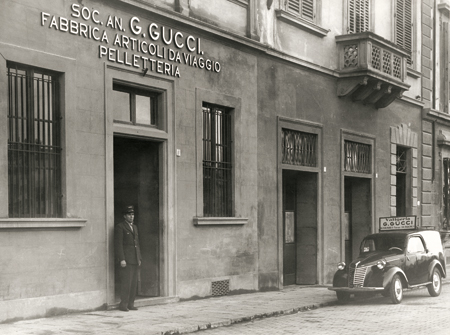
The story of Guccio Gucci, founder of the House of Gucci in 1921, is strongly connected with Florence. He was born in San Miniato in 1881 to Gabriello, a local artisan from the province of Pisa, and Elena Santini, who came from Lastra a Signa, near Florence. In 1898, at just 17 years old, he chose to leave Italy in search of better opportunities, partly driven by the collapse of his father’s straw hat business—an industry that, at the time, represented the height of quality and fashion in Europe.
He initially moved to Paris and later to London, where he found work as a porter at the prestigious Savoy Hotel. During this experience, he was exposed daily to the world of luxury and high society. He became particularly fascinated by the refined luggage produced by H.J. Cave & Sons, used by wealthy guests. This environment helped shape his keen eye for craftsmanship and elegance. Interestingly, one of the earliest symbols associated with his future brand—long before the iconic double G—featured a knight in armor carrying a travel bag, reflecting his early connection to travel goods. After four years abroad, he returned to Florence and began selling luggage, gloves, and leather accessories. When he returned to Florence, a city distinguished for a very old tradition of high-quality materials and skilled artisans, he established a shop in 1921 that sold fine leather goods with classic styling, employing skilled workers in basic Florentine leather crafts. He then married Aida Calvelli (1879–1955), a Florentine, and together they had five children: Grimalda (1903–1989), Enzo (1904–1913), who died at a young age, Aldo (1905–1990), Vasco (1907–1974), and Rodolfo (1912–1983). Aida also had a son, Ugo Calvelli Gucci (1899–1973), from a previous relationship; he was later adopted by Guccio.
Guccio Gucci, founder of the House of Gucci in 1921, opened his first shop at 7 Via della Vigna Nuova, under the name “Azienda Individuale Guccio Gucci.” It was a modest store specializing in leather luggage, travel items, and equestrian goods. The location is just a short distance from today’s Gucci boutique on Via Tornabuoni, now known as Florence’s luxury shopping street. Over time, this small workshop grew into the renowned Gucci company, which would become a global symbol of Italian high fashion.
His business quickly gained success, attracting some of the finest craftsmen of the era. In 1938, he expanded by opening a second store in Rome, and the company gradually evolved into a family-run enterprise as his sons joined him. A further expansion followed in 1951 with the opening of a store in Milan. In few years, the brand obtained an international echo, attracting a rich and elegant customer base which appreciated its bags, suitcases, gloves, shoes and belts.
The company made handbags of cotton canvas rather than leather during World War II as a result of material shortages. In this period the bamboo-bag was created, becoming one of the icons of the House of Gucci.
Guccio Gucci passed away suddenly in 1953. He is buried in the family chapel at the Soffiano cemetery, associated with the Venerable Archiconfraternity of Mercy of Florence. After his death, his sons Aldo and Rodolfo carried on and further developed the family business.
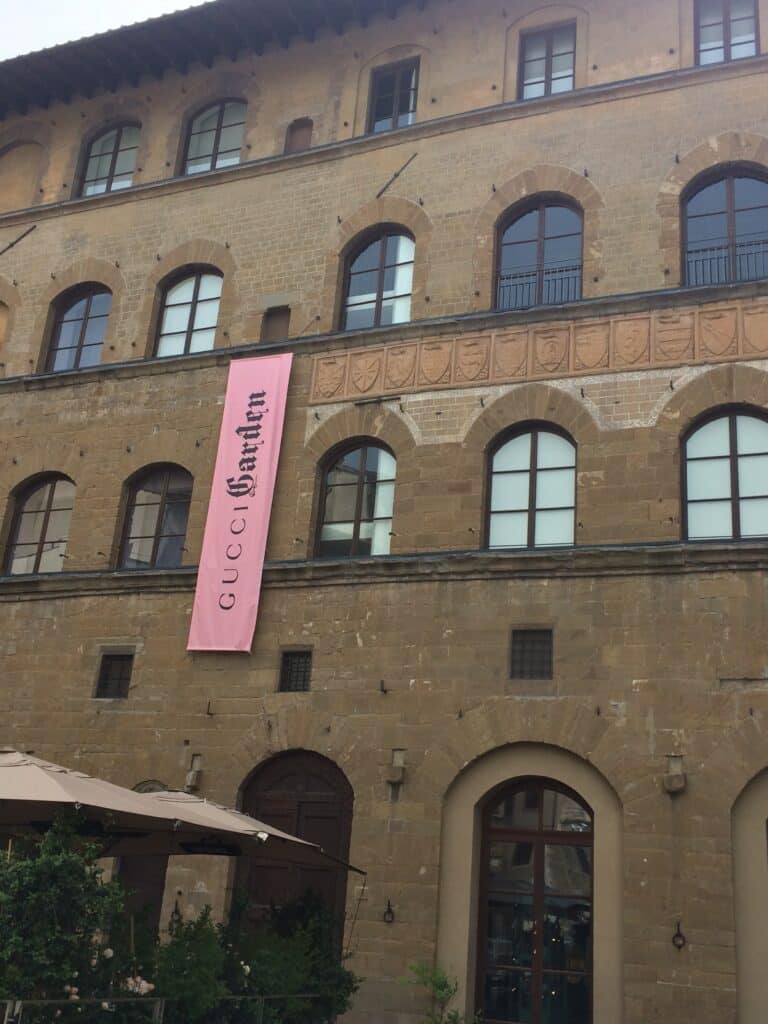
Today, if are interested in discovering the story of Guccio Gucci, founder of the House of Gucci, a must-do is a visit of the Gucci Museum, opened in 2011 to mark ninety years since the brand was founded in Florence. It is the city’s second museum dedicated to a fashion house, following the Salvatore Ferragamo Museum, which first opened its doors to the public in 1995. Its location is highly symbolic: the Palazzo della Mercanzia, or “Palace of Merchants,” once housed a tribunal that settled disputes among Florence’s powerful guilds, including those of the textile trade, which helped establish the city as a major commercial center in Europe.
This setting reflects Florence’s long-standing tradition of craftsmanship—one that also includes Gucci, which originally began as a maker of luggage and leather goods. In this way, the museum underscores the Florentine roots of a brand that has grown into a global icon.
Guccio Gucci, founder of the House of Gucci, could hardly have imagined that one day a museum would be dedicated to his company in his hometown.