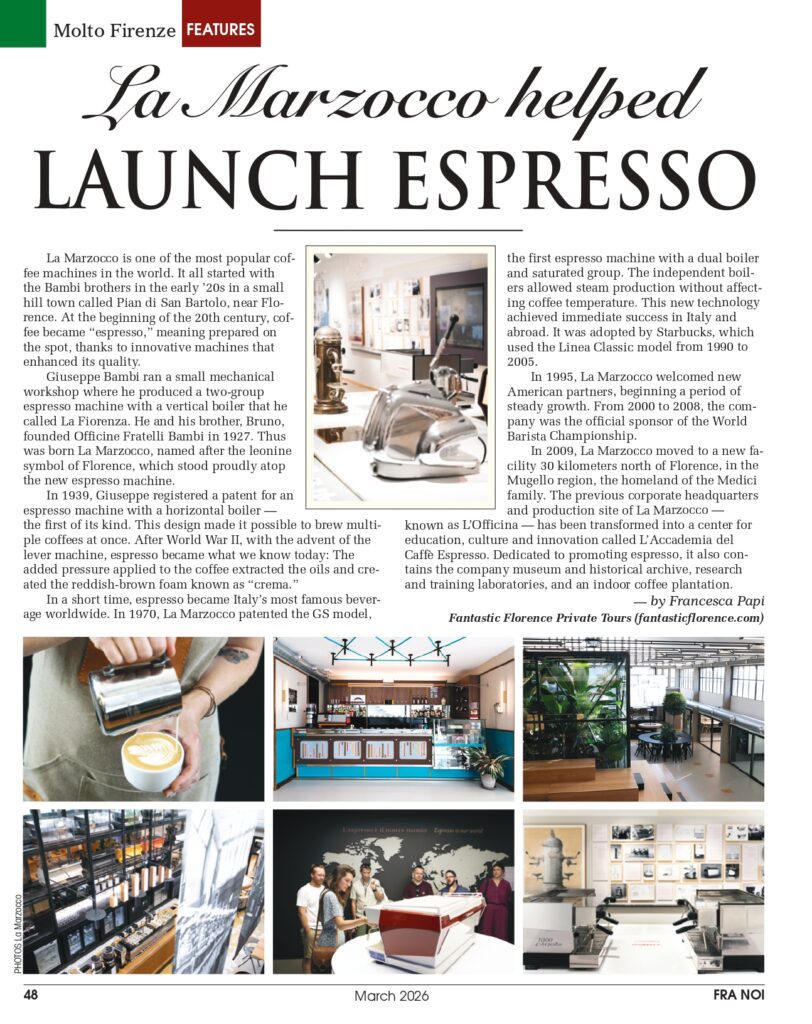
Today, I want to tell you about two brothers in the early 20’s, not too far from my home in Fiesole: the story of La Marzocco coffee machines. Actually everything started in a small town called Pian di San Bartolo. At the beginning of the 20th century, coffee became “espresso,” meaning prepared on the spot, thanks to innovative espresso machines that enhanced its quality. This exotic beverage became the focus of advertising campaigns aimed at promoting its popularity, and espresso coffee eventually arrived in the cradle of the Renaissance—Florence. Here, a young Giuseppe Bambi ran a small mechanical workshop, where an entrepreneur, Mr. Ascanio Galletti, commissioned him to produce a two-group espresso machine with a vertical boiler, called La Fiorenza. Fiorenza was the medieval name of Florence. Giuseppe Bambi decided to go into partnership with his brother Bruno to create their own model. Together, they founded Officine Fratelli Bambi in 1927.
Thus, La Marzocco was born—named after the Marzocco, the lion symbol of Florence, which stood proudly atop the new espresso machine.
The Marzocco, symbol of Florence
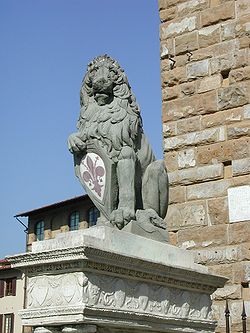
But, what is the Marzocco? In the Florentine Republic, the Marzocco was a lion symbolizing popular power. The term has uncertain etymology, but it is generally linked to the Latin martius, meaning “of Mars.” An earlier representation can be seen on the weather vane of Palazzo Vecchio. Among others, Dante mentions the common belief that the city of Florence was once dedicated to Mars. According to him, there had been a Roman statue of the god, originally located in the forum and later placed near the Ponte Vecchio, which was swept away by the flood of 1333.
Donatello’s Marzocco is the most celebrated representation of this emblem. The statue was commissioned by the Florentine Republic on the occasion of Pope Martin V’s visit to the city. It was originally intended to decorate the staircase of the papal apartments in Santa Maria Novella. Later, it was moved to Piazza della Signoria as a symbol of the Republic itself.
Today, Donatello’s Marzocco is preserved in the Bargello Museum. Nevertheless, a copy still stands in Piazza della Signoria in front of Palazzo Vecchio. Here, once a year—on the feast of Saint John the Baptist, patron saint of Florence (June 24th)—the Order of the Parte Guelfa honors it with the traditional coronation ceremony.
La Marzocco coffee machines grows up
In 1939, Giuseppe Bambi registered a patent for an espresso machine with a horizontal boiler—the first of its kind. This design made it possible to brew multiple coffees at once. World War II forced the brothers to halt production, as all industrial activity in the country was redirected toward the war effort. After the war, with the advent of the lever machine, espresso became what we know today: the strong pressure of 14 bars applied to the coffee extracted the oils and created the crema. In a short time, espresso became Italy’s most famous beverage worldwide. La Marzocco also began producing a series of lever machines.
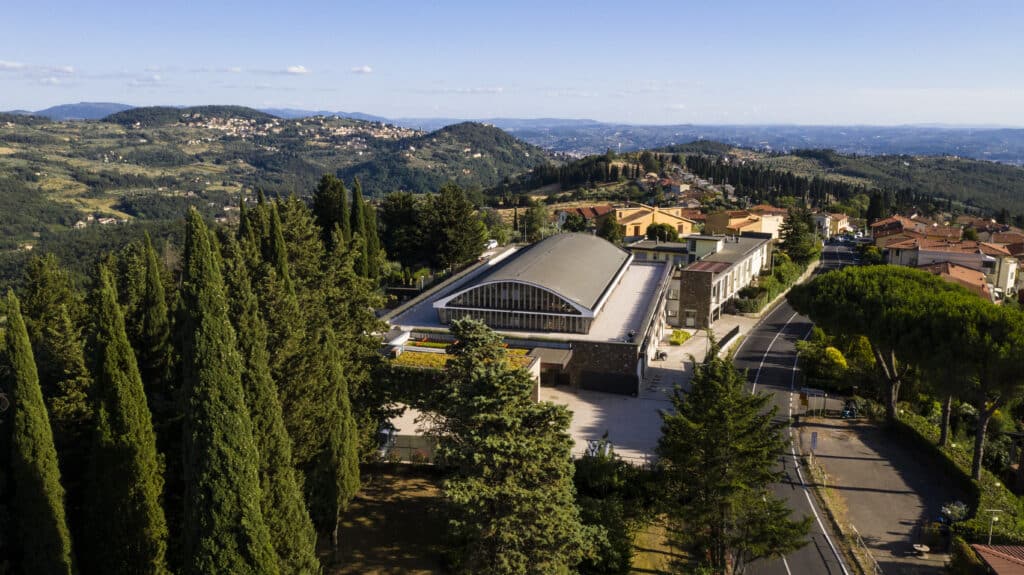
In 1961, the Bambi brothers opened their own factory on the hills north of Florence, where they added a woodworking shop alongside espresso machine production to create café furnishings.
In 1966, when Florence was devastated by the terrible flood of November 4, the Bambi brothers—whose factory, being on higher ground, was spared—offered free assistance to their customers to help them reopen their businesses as quickly as possible.
La Marzocco coffee machines and the US market
In 1970, La Marzocco patented the GS model, the first espresso machine with a dual boiler and saturated group. The independent boilers allowed steam production without affecting coffee temperature. “GS” stood for Gruppo Saturo (“Saturated Group”): the brewing groups, directly connected to the boiler and designed for continuous water circulation. This allowed to maintain a stable temperature and produced exceptional coffee. This new technology achieved immediate success in Italy and especially abroad, where it was adopted by Starbucks, which began using the Linea Classic model in 1990 and continued with La Marzocco until 2005.
In 1995, La Marzocco welcomed new American partners, beginning a period of steady growth under a new generation. The product line was renewed, and the brand opened up to new markets. From 2000 to 2008, La Marzocco was the official sponsor of the World Barista Championship.
La Marzocco now-a-days: the Accademia del Caffè Espresso
In 2009, La Marzocco moved to a new facility 30 km north of Florence, in Scarperia, in the Mugello region—the homeland of the Medici family. Since then, La Marzocco has created nine espresso machines, including the Strada, ideal for specialty coffees; the Linea Mini, designed for home espresso enthusiasts; and the Linea Micra, the first machine created exclusively for home use.
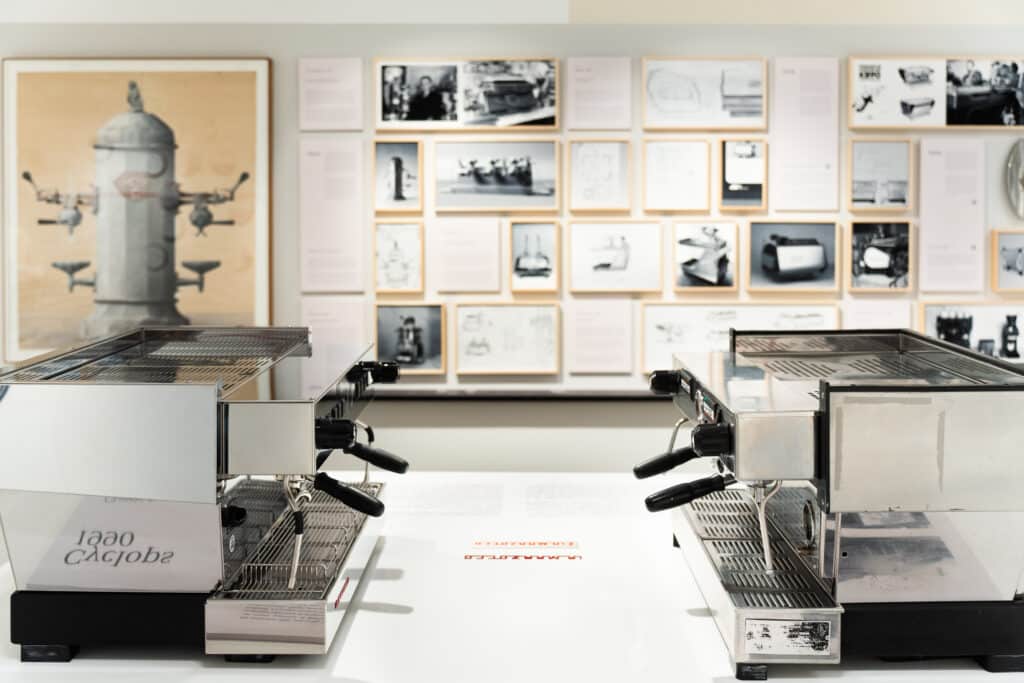
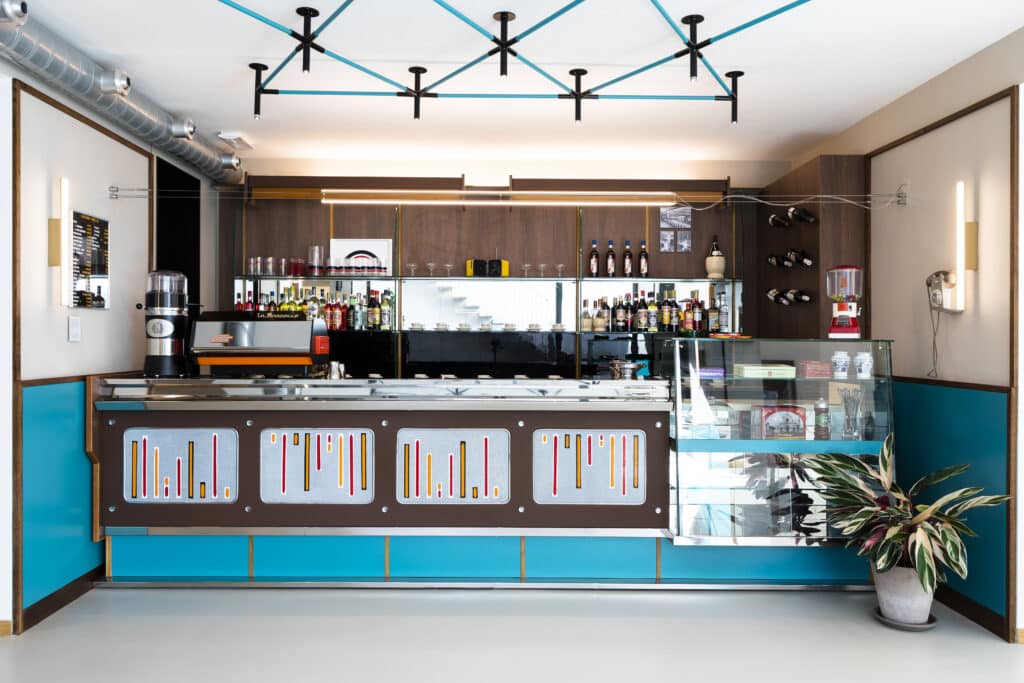
The Accademia del Caffè Espresso is reborn within the Officina—the historic headquarters of La Marzocco from 1960 to 2009. Once an industrial production site, it has now been transformed into a center for education, culture, and innovation. The Accademia del Caffè Espresso is a cultural institution dedicated to promoting espresso coffee. The Accademia today brings together the La Marzocco company museum, the historical archive, an indoor coffee plantation, research and training laboratories, and the Officine Fratelli Bambi—a true mechanical workshop devoted to the design and construction of custom espresso machines.
I warmly suggest you to book a visit at the Accademia del Caffè Espresso. It’s funny, interesting and entertaining. I love to support excellent realities in my little community of Fiesole. A great experience, off-the-beaten-paths is my tour f Fiesole combined with the visit of La Marzocco. A memorable experience is guaranteed!
You can also check out my article about La Marzocco on the Italian-American magazine of Chicago Fra Noi, where I have my Molto Firenze column!